
If you have a website, blog, online store, or business, you have probably heard the term SEO. But what exactly does SEO mean, how does it work, and why is it important for getting more visitors from Google?
SEO, or Search Engine Optimization, is the process of improving a website and its content so that search engines can better understand it and users can discover it through relevant search queries. SEO is not about tricking Google or guaranteeing a first-page ranking. Instead, effective SEO focuses on creating useful content, building a technically accessible website, understanding what people search for, and making it easier for search engines to discover and understand your pages.
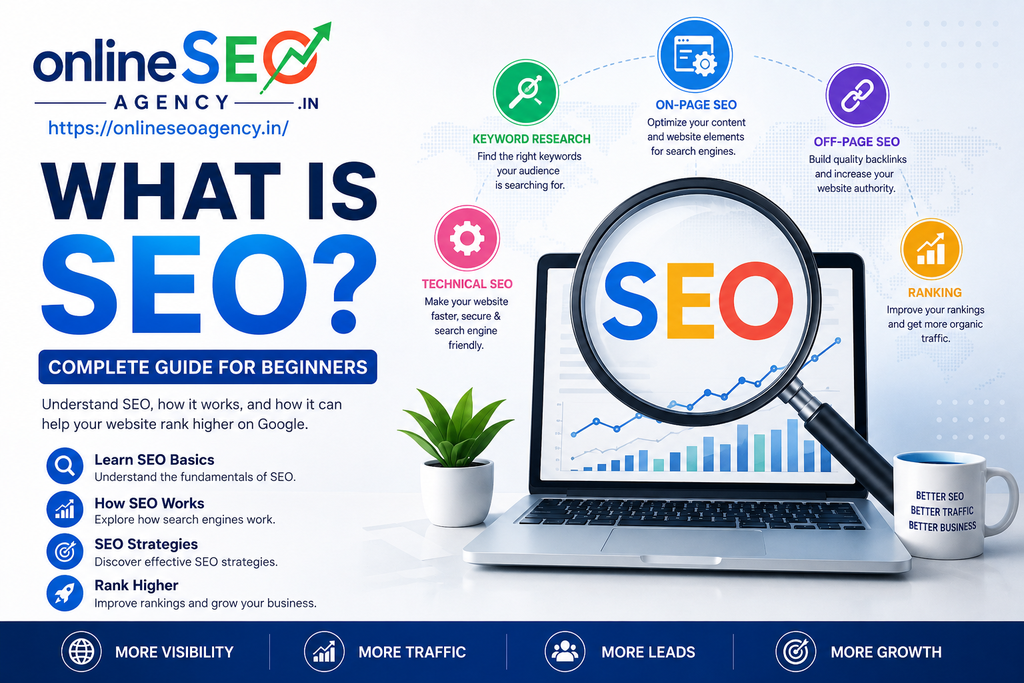
Google describes SEO as helping search engines understand your content and helping users find your website through search. Its current SEO Starter Guide also emphasizes that there are no secret techniques that automatically guarantee a first-place ranking.
In this complete SEO guide for beginners, you will learn what SEO is, how search engines work, why SEO matters, the different types of SEO, keyword research, on-page SEO, technical SEO, off-page SEO, local SEO, content optimization, common SEO mistakes, and practical SEO tips you can start using today.
What Is SEO?
SEO (Search Engine Optimization) is the practice of improving a website so that search engines can crawl, understand, index, and potentially rank its pages for relevant searches.
When someone searches for something on Google, the search engine has to identify pages that are relevant to that query and decide which results are most useful to show. SEO helps your website communicate its topic and value more effectively.
For example, imagine you own a website selling handmade furniture in Mumbai. A potential customer might search for:
- “custom furniture in Mumbai”
- “wooden dining table Mumbai”
- “best furniture shop near me”
- “custom furniture manufacturer”
- “modern wooden furniture”
If your website has useful pages targeting these needs, has a logical structure, loads properly, and provides valuable information, SEO can help search engines understand those pages.
However, SEO is not simply adding keywords to a page. Modern search engines use sophisticated systems to understand language, intent, context, relevance, and quality.
The best SEO strategy therefore starts with the user rather than the search engine.
Why Is SEO Important for a Website?
The internet is crowded. Thousands of websites may offer similar products, services, or information. Having a website alone does not guarantee that people will find it.
This is where SEO marketing becomes important.
A strong SEO strategy can help your website:
- Increase organic search visibility
- Attract relevant visitors
- Build brand awareness
- Generate leads
- Increase online sales
- Establish industry authority
- Reduce dependence on paid advertising
- Reach people actively searching for your products or services
For example, someone searching for “SEO services in Mumbai” already has a specific need. Appearing prominently for a relevant query can put your business in front of that person at the right stage of their buying journey.
Organic search traffic can also continue after the initial optimization work, although rankings and traffic are never guaranteed and require ongoing improvement.
Google notes that changes to a website can take anywhere from hours to several months to show an impact, so SEO should be treated as a long-term process rather than an overnight traffic solution.
How Does SEO Work?
Understanding how SEO works becomes easier when you understand how Google Search works.
Google broadly describes Search in three stages:
- Crawling
- Indexing
- Serving search results
1. Crawling
Search engines use automated programs called crawlers to discover and access web pages.
Google’s crawler, commonly known as Googlebot, follows links and discovers new or updated pages across the web. A website needs to be accessible to Google’s crawler for its content to be considered for indexing.
For example, when you publish a new blog post and link to it from another accessible page, Google may discover that URL while crawling your website.
2. Indexing
After crawling a page, Google analyzes its content and attempts to understand what the page is about.
The search engine can process elements such as:
- Page text
- Title
- Headings
- Images
- Alt attributes
- Links
- Other page information
Google then stores information about eligible pages in its index.
3. Ranking and Serving Results
When someone performs a search, Google’s systems retrieve potentially relevant pages from its index and determine which results are appropriate for the query.
Search results can vary based on factors such as the query, language, location, device, and other context.
This is why SEO ranking is not controlled by one single factor.
What Are the Different Types of SEO?
SEO is a broad discipline. The main types of SEO include:
- On-Page SEO
- Technical SEO
- Off-Page SEO
- Local SEO
- Content SEO
- Image SEO
- E-commerce SEO
Each area addresses a different part of website visibility.
What Is On-Page SEO?
On-Page SEO involves optimizing elements on your website and individual pages to make them useful and understandable for both users and search engines.
Important on-page SEO techniques include:
- Optimizing page titles
- Writing useful meta descriptions
- Using descriptive headings
- Creating readable URLs
- Optimizing content
- Using relevant keywords naturally
- Adding internal links
- Optimizing images
- Improving content structure
For example, suppose your target topic is “SEO for beginners.”
A weak title might be:
Welcome to Our Blog
A more descriptive SEO title would be:
SEO for Beginners: Complete Guide to Search Engine Optimization
The second title gives users and search engines a much clearer understanding of the page.
What Is Keyword Research?
Keyword research is the process of identifying words and phrases people use when searching for information, products, services, or solutions.
It is one of the foundations of a successful SEO strategy.
For example, if you are creating a website about SEO, your keyword research might identify terms such as:
- SEO
- what is SEO
- SEO for beginners
- SEO services
- technical SEO
- on-page SEO
- local SEO
- keyword research
- SEO tools
- how to rank on Google
But keyword research is not simply about finding keywords with high search volume.
You should also consider:
- Search intent
- Competition
- Relevance
- Business value
- Long-tail variations
- Content requirements
A highly competitive keyword may generate thousands of searches but be difficult for a new website to rank for. A more specific long-tail keyword may have fewer searches but attract visitors with stronger intent.
What Is Search Intent?
Search intent describes the reason behind a user’s search.
Understanding search intent can significantly improve your content strategy.
There are four common categories.
Informational Intent
The user wants information.
Example:
What is SEO?
Navigational Intent
The user wants to reach a specific website or brand.
Example:
Google Search Console
Commercial Investigation
The user is researching options before making a decision.
Example:
Best SEO tools for beginners
Transactional Intent
The user is ready to take an action such as purchasing or booking.
Example:
Buy SEO software
Successful SEO content should match the intent behind the search query instead of simply repeating the keyword.
What Is Technical SEO?
Technical SEO focuses on improving the technical aspects of a website so search engines can efficiently crawl and understand its pages.
Important technical SEO factors include:
- Website crawlability
- Indexability
- XML sitemaps
- Robots.txt
- Canonical URLs
- HTTPS
- Mobile usability
- Site architecture
- Page speed
- Core Web Vitals
- Redirects
- Structured data
- Internal linking
- Broken links
Google’s technical requirements state that a page needs to be accessible to Googlebot, return a successful HTTP response, and contain indexable content to be eligible for indexing. Meeting those requirements does not guarantee indexing or ranking, but they form an important technical foundation.
Example of a Technical SEO Problem
Imagine you publish 50 excellent blog posts, but your website accidentally blocks Google’s crawler from accessing them.
Your content may be excellent, but search engines may not be able to properly crawl it.
This is why technical SEO should not be ignored.
What Is Off-Page SEO?
Off-Page SEO refers to activities that take place outside your website and can contribute to your website’s reputation, authority, and visibility.
One well-known area is link building.
When another relevant website links to your content, that link can help users discover your website and may contribute to how search engines understand your site’s prominence and relationships.
However, effective link building should focus on quality and relevance rather than collecting thousands of low-quality links.
Useful off-page SEO activities can include:
- Earning editorial backlinks
- Digital PR
- Publishing original research
- Building relationships within your industry
- Business citations
- Relevant guest contributions
- Brand mentions
- Promoting useful resources
Avoid manipulative link schemes. A small number of relevant, naturally earned links can be more valuable than a large collection of irrelevant links.
What Is Local SEO?
Local SEO helps businesses improve their visibility for searches connected to a specific location.
It is particularly useful for:
- Restaurants
- Doctors
- Salons
- Digital marketing agencies
- Educational institutes
- Retail stores
- Plumbers
- Lawyers
- Real estate businesses
- Local service providers
For example, a user searching for:
“SEO agency in Mulund”
has a very different intent from someone searching for:
“What is SEO?”
A local business should optimize its website and relevant business profiles to clearly communicate its location, services, contact information, and business details.
A good local SEO strategy can include:
- Google Business Profile optimization
- Location-specific website pages
- Local keyword research
- Local citations
- Reviews
- Local content
- Relevant local links
- Consistent business information
What Is Content SEO?
Content SEO focuses on creating and optimizing content that satisfies users and aligns with relevant searches.
Good content should answer the reader’s question clearly and provide enough context to help them accomplish their goal.
For example, instead of writing a 500-word article simply because a keyword has high search volume, create a useful resource that answers the questions your target audience actually has.
Google’s current guidance recommends content that is original, comprehensive, helpful, reliable, and created primarily for people. It also recommends evaluating whether your content adds substantial value compared with other pages in search results.
How to Create SEO-Friendly Content
A practical SEO content strategy can follow these steps:
Step 1: Choose a Relevant Topic
Start with a topic that is genuinely useful to your audience.
Step 2: Research Keywords
Identify the main keyword and closely related searches.
Step 3: Understand Search Intent
Determine what users expect when searching for the topic.
Step 4: Create a Useful Outline
Organize the article using logical H2 and H3 headings.
Step 5: Add Original Value
Include examples, personal experience, data, screenshots, case studies, or practical recommendations where appropriate.
Step 6: Optimize the Page
Improve the title, URL, headings, images, internal links, and metadata.
Step 7: Review Before Publishing
Check accuracy, readability, grammar, links, formatting, and user experience.
Step 8: Monitor Performance
Use tools such as Google Search Console to understand impressions, clicks, queries, CTR, and ranking performance.
Google specifically recommends creating content that demonstrates first-hand expertise and provides a satisfying experience for readers rather than producing content mainly to attract search-engine visits.
What Are Internal Links?
Internal linking means linking one page on your website to another page on the same website.
For example, in this article about SEO, you could naturally link to future articles about:
- Technical SEO
- Keyword Research
- On-Page SEO
- Local SEO
- Link Building
- SEO Tools
Internal links help readers discover related information and help search engines understand relationships between pages.
A strong internal linking structure can look like this:
SEO Guide
↓
Technical SEO
↓
On-Page SEO
↓
Keyword Research
↓
Local SEO
↓
SEO Tools
Instead of creating isolated blog posts, build connected topic clusters around your most important subjects.
What Are SEO-Friendly URLs?
An SEO-friendly URL should be clear, descriptive, and easy for users to understand.
For example:
Good:
example.com/what-is-seo
Less useful:
example.com/page?id=93847
A descriptive URL helps communicate what the page is about.
For a blog titled What Is SEO? Complete Guide for Beginners, a clean URL could be:
/blog/what-is-seo
Keep URLs simple and avoid unnecessary words, numbers, or complicated parameters when they do not serve a useful purpose.
What Are Meta Titles and Meta Descriptions?
The SEO title is an important page element that helps describe your page.
A strong title should be:
- Relevant
- Descriptive
- Clear
- Compelling
- Appropriate for the page
For this article, an example could be:
What Is SEO? Complete Beginner’s Guide to SEO
A meta description provides a short summary that may be shown in search results.
Example:
Learn what SEO is, how search engines work, and how to improve your website rankings with this complete SEO guide for beginners.
A compelling title and description can help users understand what they will find when they visit your page.
How Important Are Backlinks for SEO?
Backlinks are links from external websites pointing to your website.
They can help with discovery and can contribute to your site’s reputation and authority when they come from relevant, trustworthy sources.
For example, imagine you publish an original study about SEO trends. A respected marketing publication discovers your research and links to it as a source.
That is much more meaningful than receiving hundreds of unrelated links from low-quality websites.
The best approach to SEO link building is to create resources people genuinely want to reference.
Some link-worthy assets include:
- Original research
- Statistics
- Industry studies
- Detailed guides
- Free tools
- Templates
- Case studies
- Expert interviews
- Original visual resources
What Are SEO Tools?
SEO tools help marketers and website owners research, monitor, audit, and improve their websites.
Popular categories include:
Keyword Research Tools
Used to discover search queries and keyword opportunities.
Website Audit Tools
Used to identify technical and on-page issues.
Rank Tracking Tools
Used to monitor keyword positions.
Backlink Tools
Used to analyze links and referring domains.
Analytics Tools
Used to understand website traffic and user behavior.
Search Performance Tools
Google Search Console is particularly important because it provides information about a site’s performance and indexing in Google Search.
You don’t need every SEO tool available. Choose tools based on the problems you are trying to solve.
Common SEO Mistakes Beginners Should Avoid
Keyword Stuffing
Repeating the same keyword unnaturally can make content difficult to read.
Use keywords naturally and focus on answering the user’s question.
Publishing Duplicate Content
Creating several pages that provide almost identical information can create confusion and dilute your site’s focus.
Ignoring Search Intent
A page may target the correct keyword but still fail to satisfy what users actually want.
Buying Low-Quality Backlinks
Avoid shortcuts involving irrelevant or manipulative links.
Ignoring Technical SEO
Great content cannot reach its full potential if search engines cannot properly access or understand your pages.
Writing Only for Search Engines
Google’s current guidance strongly emphasizes people-first content. Content should have a clear purpose for the audience and provide genuine value.
Expecting Instant Results
SEO is a long-term process. Google states that changes can take different amounts of time to be reflected in Search, from hours to several months depending on the change and circumstances.
How to Improve Your Google Rankings
There is no guaranteed formula for getting to Google’s first page.
Anyone promising a guaranteed first position should be treated cautiously. Google itself states that there are no secrets that automatically rank a website first.
Instead, concentrate on fundamentals:
Create Better Content
Answer the searcher’s question more completely and clearly than competing pages.
Improve Technical SEO
Make sure your website is crawlable, indexable, fast, accessible, and logically structured.
Build Topical Authority
Cover important topics comprehensively instead of publishing disconnected articles.
Improve Internal Linking
Connect related pages naturally.
Earn Relevant Backlinks
Create resources that other websites want to reference.
Monitor Search Console
Identify which pages and queries are generating impressions and clicks, then improve them.
Update Existing Content
Keep important information accurate and useful as topics change.
How Long Does SEO Take to Work?
One of the most common SEO questions beginners ask is:
“How long does SEO take?”
There is no universal answer.
A new website may take time to establish visibility, while an established website with strong authority may see changes sooner.
Google explains that changes can take anywhere from hours to several months to show an effect in Search, and not every change produces a noticeable ranking improvement.
Instead of expecting immediate traffic, monitor progress through:
- Indexed pages
- Organic impressions
- Organic clicks
- Keyword rankings
- CTR
- Referring domains
- Engagement
- Leads or conversions
Think of SEO as an ongoing improvement process rather than a one-time task.
SEO and AI: What Is Changing?
The future of SEO is increasingly connected with AI.
Search engines are incorporating AI-powered experiences, while users are also turning to AI systems to discover information.
This does not mean traditional SEO is disappearing.
In fact, strong fundamentals remain important.
A website still needs useful content, accessible pages, clear information architecture, internal links, and a technically sound foundation.
For businesses and bloggers, the opportunity is to combine traditional SEO best practices with AI-assisted research, content analysis, automation, and strategy.
The important distinction is this:
Use AI to improve your SEO workflow—not to replace expertise or mass-produce low-value content.
Google’s current guidance specifically warns against using automation, including AI generation, primarily to manipulate search rankings.
A Simple SEO Strategy for Beginners
If you’re completely new to SEO, don’t try to implement everything at once.
Start with this five-step process:
Step 1: Make Your Website Technically Accessible
Check indexing, crawlability, HTTPS, mobile usability, site structure, and page performance.
Step 2: Research Your Audience
Understand what your potential visitors search for and what problems they want to solve.
Step 3: Create Helpful Content
Build articles and service pages that answer real questions and demonstrate your knowledge.
Step 4: Connect Your Content
Use internal links to build topic clusters.
Step 5: Measure and Improve
Use Google Search Console to monitor performance and identify opportunities.
Google recommends using Search Console to understand how your site performs in Search and to identify potential indexing problems.
Frequently Asked Questions About SEO
1. What is SEO in simple words?
SEO, or Search Engine Optimization, is the process of improving a website so search engines can understand its content and users can find it through relevant searches. It includes content optimization, keyword research, technical improvements, internal linking, local optimization, and other activities that can improve a website’s search visibility.
2. How does SEO help a website?
SEO helps a website become more discoverable for relevant searches. A successful SEO strategy can increase organic visibility, attract targeted visitors, generate leads, build brand awareness, and support online growth. However, SEO does not guarantee a particular ranking or amount of traffic.
3. What are the main types of SEO?
The major types of SEO include on-page SEO, technical SEO, off-page SEO, local SEO, content SEO, image SEO, and e-commerce SEO. These areas work together to improve a website’s visibility, usability, discoverability, and relevance.
4. How long does it take to rank on Google?
There is no fixed timeframe for Google rankings. Results depend on factors such as competition, website history, content quality, technical health, authority, search demand, and the quality of your SEO implementation. Google states that changes can take from hours to several months to show an impact.
5. Can I do SEO myself?
Yes. Beginners can learn and implement many SEO techniques themselves. Start with keyword research, useful content, basic on-page SEO, internal linking, technical SEO fundamentals, and Google Search Console. As a website grows, professional SEO support can help with advanced technical audits, content strategy, competitive research, digital PR, and larger-scale optimization.